CoBOP (Coastal
Benthic Optical Properties)
The goal of CoBOP is to investigate the optical properties
of shallow waters and the shallow sea floor. Specific science
objectives are:
- to define and develop the means to measure the inherent optical
properties associated with coastal benthic environments;
- to verify radiative transfer models for optically-shallow
water in controlled field tests;
- to investigate the relationships between measured benthic
optical properties and associated biological, chemical and physical
processes.
This last goal recognize that the optical properties of shallow
water coastal environments are a complex function of the physical
and biogeochemical processes occurring both in the sediments and
in the water column. Furthermore, they acknowledge that developing
models of the optical properties of these environments requires
further information about the processes affecting light alteration
and modification by biogeochemical reactions in surficial sediments
and at the sediment-water interface.
The work we are carrying out in CoBOP involves examining one
aspect of this problem, namely:
- the processes affecting the production of colored dissolved
organic matter (CDOM) in sediment pore waters,
- the mechanism(s) by which this material may be transported
out of sediments,
- the impact of pore water CDOM on the optical properties of
the shallow water benthos (i.e., the sediments, the sediment-water
interface and the waters overlying the sediment, including the
benthic boundary layer).
The majority of the work in CoBOP is carried out in carbonate
sediments near the Caribbean Marine
Research Center on Lee Stocking Island, in the Exumas chain
in the Bahamas.
Links to
our CoBOP data
Links to
CoBOP (and other) publications
Images of the
Bahama Banks and Lee Stocking Island from the air
Pictures from our CoBOP field effort
at LSI in May/June, 1999

Lee Stocking Island (looking north)
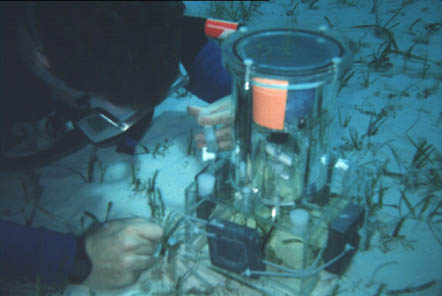 Sampling an In Situ Benthic Flux
Chamber
Sampling an In Situ Benthic Flux
Chamber
return to the Sediment Biogeochemistry
Page