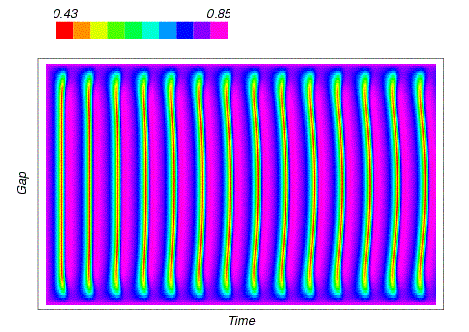
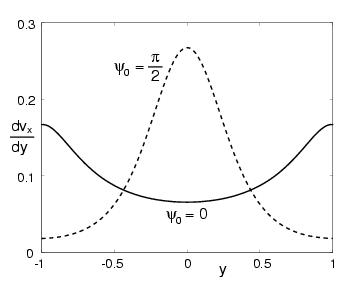
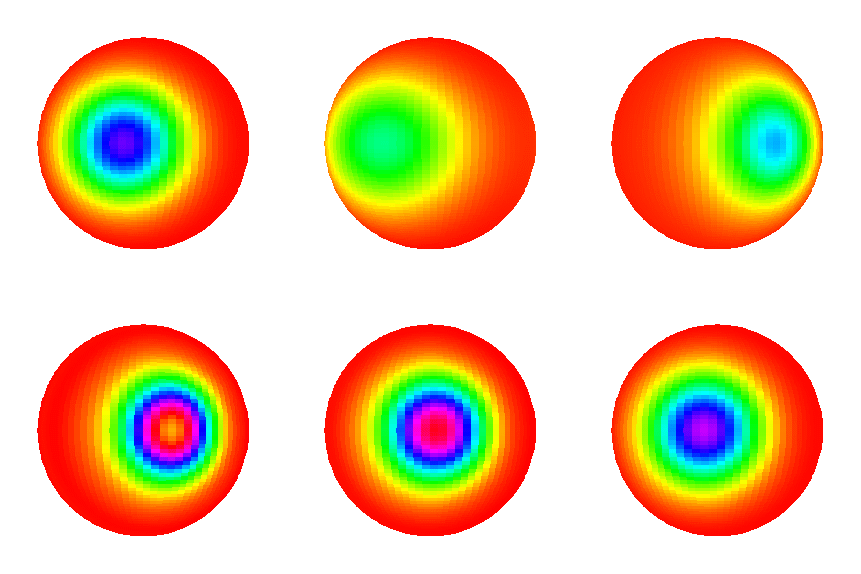
The flow structure of Leslie angle for N=6, De=6, Er=50, with parallel anchoring.
Spatial coherence, rheological chaotic dynamics, and hydrodynamic feedback of nematic polymers in plate-driven shear
By M.G. Forest, R.Zhou, Q. Wang
Rheochaos arising from bulk orientational dynamics of nematic (liquid crystalline) polymers in simple shear is well established. Here we address the persistence of chaotic phe- nomena in the presence of spatial gradient morphology in the rigid rod ensemble and flow field. We simulate the Doi-Hess kinetic theory with a Marrucci-Greco distortional elasticity potential, and hydrodynamic feedback. Opposing parallel plate speeds are chosen to resonate bulk rheochaos, and elasticity constants are selected so that the nematic suspension cannot store plate-generated stresses, staging an unsteady experiment. We are motivated by spatio-temporal chaos with a second-moment tensor (5 component) nematic liquid model with imposed simple shear, extended here to 65 component resolution of the orientational distribution with flow coupling. We find a spatially coherent, temporally chaotic attractor with: an interior layer with chaotic orientational dynamics and velocity 0uctuations at each gap height; layers buffering the plates with regular kayaking orbits at each location; spatial coherence and laminar structure at every timestep in all features (flow, orientational distribution, and stresses).
Anisotropy and heterogeneity of nematic polymer nano-composite film properties
By M.G. Forest, R.Zhou, X. Zheng, Q. Wang, R. Lipton
Nematic polymer nanocomposites (NPNCs) are comprised of large as- pect ratio rod-like or platelet macromolecules in a polymeric matrix. Anisotropy and heterogeneity in the e ective properties of NPNC films are predicted in this article. To do so, we combine results on the flow-processing of thin lms of nematic suspensions in a planar Couette cell, together with homogenization results for the e ective conductivity tensor of spheroidal inclusions in the low volume fraction limit. The orientational probability distribution function (PDF) of the inclusions is the central object of Doi-Hess-Marrucci-Greco theory for flowing nematic polymers. From recent simulations, the PDF for a variety of anisotropic, heterogeneous thin films is applied to the homogenization formula for effective conductivity. The principal values and principal axes of the e ective conductivity tensor are thereby generated for various film processing conditions. Dynamic fluctuations in film properties are predicted for the significant parameter regime where the nematic polymer spatial structure is unsteady, even though the processing conditions are steady.
Kinetic structure simulations of nematic polymers in plane Couette cells, II: In-plane structure transitions
By M. Gregory Forest, Ruhai Zhou, Qi Wang
Nematic, or liquid crystalline, polymer (LCP) composites are comprised of large aspect ratio rod-like or platelet macromolecules. They show tremendous potential for high performance material applications, ranging across mechanical, electrical, piezoelectric, thermal, and barrier properties. Fibers made from nematic polymers have set synthetic materials perfor- mance standards for decades. The current target is to engineer films and molded parts with multi-functional high performance properties, for which processing flows are shear-dominated. Nematic polymer films inherit anisotropy from collective orientational distributions of the molecular constituents, and develop heterogeneity on lengthscales that are, as yet, not well understood and thereby uncontrollable. LCPs in viscous solvents have a theoretical and com- putational foundation from which one can model parallel plate Couette cell experiments, and explore anisotropic structure generation arising from non-equilibrium interactions between hydrodynamics, molecular short- and long-range elasticity, and con/nement e.ects. Recent progress on the longwave limit of homogeneous nematic polymers in imposed simple shear and linear planar flows provides resolved kinetic simulations of the molecular orientational distribution. These results characterize anisotropy of homogeneous domains, parametrized by imposed linear 0ow and molecular parameters. In this paper, we apply our recent kinetic structure code to model heterogeneity arising from a distortional elasticity potential (with distinct elasticity constants) and anchoring conditions in a plane Couette cell. For this initial study, the flow field is imposed and the orientational distribution is con/ned to the shear deformation plane, which a.ords comparison with seminal mesoscopic simulations. Under these controlled conditions, we map out the kinetic phase diagram of spatio-temporal attractors of a Couette cell film in the two-parameter space of Deborah number (normalized shear rate) and Ericksen number (relative strength of elasticity potentials). Phase transitions of structure attractors are identified for both tangential and normal molecular anchoring conditions at the plates. Results presented here serve two purposes for materials engineering. First, the molecular orientational distributions and stored stresses, coupled with homogenization theory of low volume fraction spheroidal inclusions, give a di- rect prediction of anisotropic, heterogeneous properties in thin LCP films. Second, the structure attractors and material properties provide a foundation for continuation studies due to release of the controls imposed here.
Kinetic structure simulations of nematic polymers in plane Couette cells, I: The algorithm and benchmarks
By Ruhai Zhou, M. Gregory Forest, Qi Wang
The Doi-Hess theory coupled with an anisotropic Marrucci-Greco distortional elasticity potential provides a kinetic, mean field description of the coupling between hydrodynamics, molecular orientation by excluded volume, and elastic distortions of flowing nematic liquid crystalline polymers (LCPs). In this paper we provide the first numerical algorithm and implementation of kinetic-scale models for structure formation in confined, planar Couette cells. The model and algorithm extend kinetic simulations of Larson and Ottinger and others for homogeneous nematic polymers in imposed shear flows. The focus here is one-dimensional flow and LCP structures that form between oppositely moving, parallel plates, a classical model problem that has been studied in detail with continuum models and a variety of mesoscopic, second-moment orientation tensor models. We benchmark the kinetic simulations against these coarse-grained predictions with a focus on delineating closure-sensitive structure phenomena. The model consists of a Smoluchowski equation for the space-time evolution of the orientational probability distribution function, coupled with a momentum flow balance equation, a constitutive equation for the extra stress, and the continuity equation. The Smoluchowski equation is first reduced to a finite set of partial differential equations in time and space for spherical harmonic amplitudes. Then we discretize the spatial variables (by the method of lines) using high-order finite differences, which reduces the full system to a large set of ordinary differential equations. Adaptive grid generation techniques are implemented. To provide an accurate and stable integration of these ordinary differential equations, we employ the newly developed spectral deferred correction algorithm. We close with an application of the kinetic theory and numerical code to explore steady state structures in slow planar Couette experiments (low Deborah number) and low Ericksen number, where distortional elasticity dominates short-range excluded volume effects. We confirm recent analytical results based on mesoscopic closure models derived from this kinetic model, both with equal and distinct Frank elasticity constants, in the low Deborah and low Ericksen limits.
Chaotic boundaries of nematic polymers in mixed shear and extensional flows
By M. Gregory Forest, Ruhai Zhou, Qi Wang
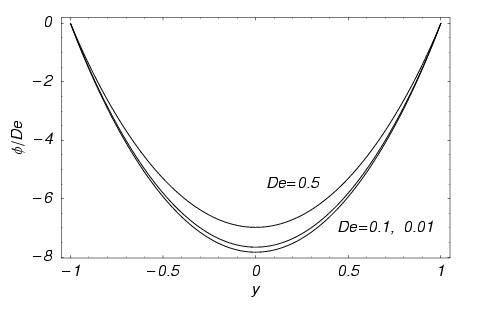
Chaotic orientational dynamics of sheared nematic polymers and wormlike micellar solutions is documented in laboratory experiments on model systems; a question arises as to how robust the phenomenon is with respect to composition and flow properties. The Doi-Hess kinetic theory for infinitely thin rods predicts chaotic monodomain dynamics over a finite range of nematic concentrations and within a window of shear rates for each concentration. Our goal here is to relax two idealizations of these numerical studies of kinetic theory, and to address the issue of robustness. Pure simple shear is modified by a planar straining flow of arbitrary strength, and the macromolecules are endowed with arbitrary aspect ratio. We then predict the deformation of the chaotic parameter region, applying a correspondence principle together with the numerical bifurcation software AUTO. We predict persistence of pure simple shear chaotic response up to a threshold straining flow component, beyond which chaotic behavior is arrested. In doing so, an intriguing prediction emerges: a finite-strength straining component can induce chaotic orientational dynamics. Indeed, all known sheared oscillatory attractors (tumbling, wagging, and kayaking) exist at shear rates below the onset of chaos, each may be driven through transitions to chaos by adding an extensional flow component of prescribed strength.
Exact scaling laws for electrical conductivity properties of nematic polymer nano-composite monodomains
Xiaoyu Zheng, M. Gregory Forest, Robert Lipton, Ruhai Zhou, Qi Wang
The purpose of this paper is to connect two critical aspects of nano-composite materials engineering. The nano-elements considered here derive from the class of high aspect ratio nematic polymers, either rod-like or platelet spheroids. First, the overall electrical properties of polymer nano-composites are well approximated by the e electrical conductivity tensor in the low volume fraction regime of the included phase. In turn, the effective conductivity is strongly in uenced by the orientation distribution of the nano-inclusions. Second, we recall results of Doi-Hess kinetic theory or mesoscopic model approximations of the orientational probability distribution, for quiescent and sheared nematic polymers, at both isotropic and ordered volume fractions. Putting the two features together, we derive the effective electrical conductivity tensor in closed form. Scaling properties of enhanced conductivity versus volume fraction and weak shear rate become explicit. The most dramatic effect is that the effective conductivity tensor inherits hysteresis, bi-stability and discontinuous jumps from the isotropic-nematic first order phase transition. These formulas reveal finer estimates depending on a competition between two inherent large parameters in nematic polymer nano-composites: the molecular aspect ratio and the conductivity ratio of the inclusions and matrix. For this first paper we restrict to steady monodomain orientational distributions at rest and in weak shear flows, which serve as benchmarks and guides for future extensions and numerical approaches.
Likelihood & Expected-time Statistica of Monodomain Attractors in Sheared Discotic and Rod-like Nematic Polymers
By Xiaoyu Zheng, M. Gregory Forest, Ruhai Zhou, Qi Wang
Employing a mesoscopic Doi tensor model, we develop transient statistical properties of sheared nematic polymer monodomains consistent with typical experimental protocols. Our goal is to convey to the experimentalist a list of expected outcomes, based not only on properties of the nematic liquid and imposed flow rate, but also on the timescale of the experiment and variability in the initial conditions. Step 1 is deterministic: we solve the model equations completely, then compile the flow-phase diagram of all monodomain attractors and phase transitions versus nematic concentration and Peclet number (shear rate normalized by molecular relaxation rate). Step 2 is to overlay on the phase diagram a statistical diagnostic of the expected time, tA, to reach a small neighborhood of every attractor A. The statistics are taken over the arbitrary quiescent director angle on the sphere, modeling experiments that begin from rest. Step 3 is to explore parameter regimes with multiple attractors, where we statistically determine the likelihood of convergence to each attractor. These statistical properties are critical for any application of theoretical models to the interpretation of experimental data. If tA is longer than the timescale of the experiment, attractor A is never fully resonated and the relevant stress and scattering predictions are those of the transients, not the attractor. In bi-stable and tri-stable parameter regimes, which are typical of nematic polymers, a distribution of monodomains of each type will populate the sample, so experimental data must be compared with weighted averages based on the likelihood of each attractor. The final step is to give statistics of shear stress and normal stress differences during the approach to each attractor type, as well as typical paths of the major director that are contrasted with the results of Van Horn et al. with Leslie-Ericksen theory.
By M. Gregory Forest, Qi Wang, Ruhai Zhou
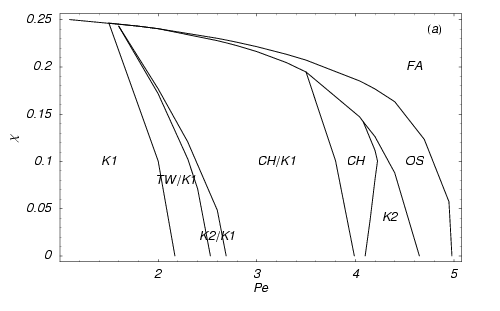
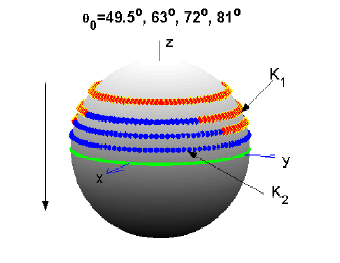
The purpose of this paper is to extend the rheological predictions of the Doi-Hess kinetic theory for sheared nematic polymers from the anomalous weak shear regime to arbitrary shear rates, and to associate salient rheological and optical properties with the solution space of kinetic theory. Using numerical bifurcation software, we provide the phase diagram of all stable monodomain orientational probability distribution functions (PDFs) and their phase transitions (bifurcations) versus nematic concentration (N) and normalized shear rate (Pe). Shear stresses, normal stress differences, the peak direction of the orientational distribution, and birefringence order parameters are calculated and illustrated for each type of PDF attractor: steady flow-aligning, both in and out of the flow deformation plane and along the vorticity axis; unsteady limit cycles, where the peak orientation direction rotates in-plane or around the vorticity axis or in bi-stable orbits tilted between them; and chaotic attractors. We pay particular attention to correlations between rheological features and the variety of monodomain phase transitions. Together with the weak flow regime, these results provide a nearly complete picture of the rheological consequences of the Doi-Hess kinetic theory for sheared monodomains of rigid, extreme aspect ratio, nematic rods or platelets.
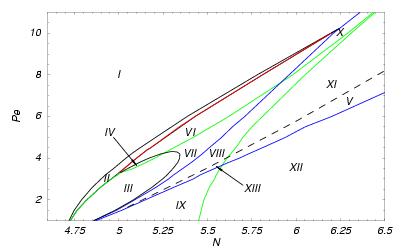
Bifurcation diagram of all stable states in (N, Pe) space.
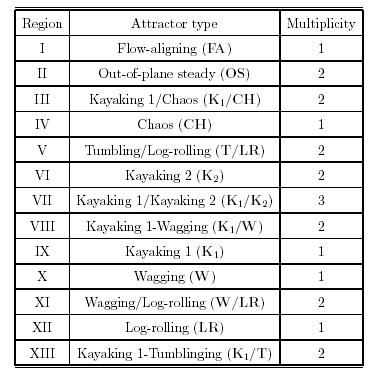
Following table lists stable state(s) for each region labelled from
(I) to (XIII).
By M. Gregory Forest, Qi Wang, Ruhai Zhou, Eric P. Choate
Various rheological devices (plane Couette cell, four-roll mill, film tenter) impose approximately linear, planar flow, from which nematic polymers have been characterized across ranges of flow type and strength. Theoretical predictions of monodomain responses of nematic liquids are predominantly for simple shear flows, studied from disparate scale models: continuum theory of Leslie-Ericksen, mesoscopic theory of Landau, deGennes and many others, and kinetic theory of Hess, Doi and Edwards. Our goal here is to establish and illustrate consequences of a monodomain correspondence principle of kinetic and mesoscopic theory for nematic polymers consisting of arbitrary aspect ratio spheroids. The principle states that the flow-phase diagram of monodisperse nematic polymers for all linear flows in the plane of shear (except pure extensional flow) follows directly from the flow-phase diagram of pure shear flow with a renormalized molecular aspect ratio parameter. With this explicit correspondence, the wealth of predictions (and available numerical codes) for nematic polymer response in simple shear can be brought to bear on different flow types and variable aspect-ratio molecular liquids. We further provide the stress correspondence principle in order to relate normal stress differences and shear stresses. We then illustrate several concrete applications: we infer monodomain response of the four-roll mill problem for a fixed aspect ratio liquid by invoking the results for horizontal shear of a variable aspect ratio nematic fluid, and we provide continuous families of planar flow types of different aspect ratio liquids that have identical monodomain dynamics.
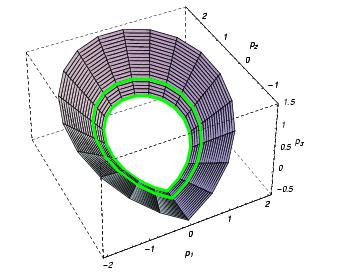
A ''surface" of linear flows. All flows associated with this surface
have equivalent monodomain dynamics: the same number, type, and stability
of stationary solutions of kinetic theory or mesoscopic closure model.
Furthermore, the solutions are all given from the kinetic or mesoscopic
theory with simple shear flow at fixed Peclet number and fixed generalized
aspect ratio.
By M. Gregory Forest, Qi Wang, Hong Zhou, Ruhai Zhou
One of the confounding issues in laminar flow processing of nematic polymers is the generation of molecular orientational structures on lengthscales that remain poorly characterized with respect to molecular and processing control parameters. For plane Couette flow within the Leslie-Ericksen continuum model, theoretical results since the 1970's yield two fundamental predictions about the lengthscales of nematic distortion: a power law scaling behavior and the variable exponent. Until now, comparable results which incorporate molecular elasticity (i.e., distortions in the shape of the orientational distribution) have not been derived from mesoscopic Doi-Marrucci-Greco (DMG) tensor models. In this paper, we derive asymptotic, one-dimensional gap structures, along the flow-gradient direction, in ''slow'' Couette cells, which reflect self-consistent coupling between the primary flow, in-plane director (nematic) and order parameter (molecular) elasticity, and confinement conditions (plate speeds, gap height, and director anchoring angle). We then read off the small Deborah number, visco-elastic structure predictions: The flow is simple shear. The orientation structures consist of: 2 molecular-elasticity boundary layers with the Marrucci scaling, which are amplified by tilted plate anchoring; and a non-uniform, director-dominated structure that spans the entire gap present for any anchoring angle. We close with direct numerical simulations of the DMG steady, flow-nematic boundary-value problem, first to benchmark the small Deborah number structure formulas, and then to document onset of new flow-orientation structures as the symptotic expansions become disordered.
By M. Gregory Forest, Ruhai Zhou, Qi Wang
Analytical descriptions of shear-aligned nematic monodomains have a long history across continuum, mesoscopic and mean-field kinetic models. Their value lies in the prediction of explicit scaling properties of the orientational distribution and of normal and shear stresses, with respect to molecular and flow parameters. At the coarsest scale of continuum Leslie-Ericksen theory, an explicit macroscopic alignment angle formula always exists in terms of bulk Miesowicz viscosities; the theory applies only to nematic (highly concentrated) liquids with low molecular weight and in the weak flow limit. At mesoscales, orientation tensor models apply at all concentrations and shear rates; explicit "Leslie angle" formulas exist only in the weak shear limit, inheriting hysteresis in alignment properties from the quiescent isotropic-nematic transition. Since the fundamental results of Onsager for quiescent nematic equilibria, exact probability distribution functions (PDFs) of kinetic theory have proven elusive for flow-driven nematic states. In their stead, flow-aligned and unsteady PDF formulas, elegant though implicit, have been derived by Kuzuu-Doi and Semenov by weak flow asymptotic analysis, and by Marrucci and Maffettone by restriction to two dimensions. A simpler problem concerns the dilute concentration regime where the quiescent equilibrium is isotropic, non-degenerate, and stable, which is the focus of this paper. Using weak-flow asymptotics, we explicitly construct, and establish stability of, stationary, shear-perturbed PDFs for dilute concentrations; our formulas prove unsteady tumbling of perturbed isotropic states cannot occur. Exact scaling properties are predicted, including explicit Leslie alignment angle and degree-of-alignment (birefringence) formulas, as well as normal and shear stresses, in terms of molecular parameters and normalized shear rate for dilute nematic polymers. Our formulas apply except in a neighborhood of the isotropic instability transition, which See, Doi and Larson analyzed by a singular perturbation analysis. We then show how to bridge our method with that of See, Doi and Larson, thereby completing the existence, construction, and stability of shear-perturbed isotropic equilibria for all concentrations. We verify the formulas both by numerical simulations and by comparison with mesoscopic model predictions.
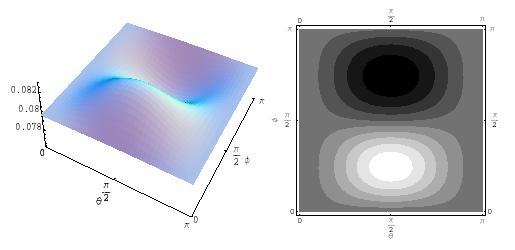
Left: The distribution function approximated by second order expansion.
Right: The contour plot of the distribution function.
By M. Gregory Forest, Qi Wang, Ruhai Zhou
We study the shear problem for nematic polymers as modeled by the molecular kinetic Doi theory, focusing on the anomalous slow flow regime. We provide the kinetic phase diagram of monodomain (MD) attractors and phase transitions versus normalized nematic concentration and weak normalized shear rate (Peclet number). We then overlay all rheological features typically reported in experiments: alignment properties, normal stress differences and shear stress. These features play a critical role in the synthesis between theory and experiment for nematic polymers. MD type is routinely used for rheological shear characterization: cf., flow-aligning 5CB, tumbling PBT and 8CB, evidence for a wagging regime, out-of-plane kayaking modes, and evidence for chaotic major director dynamics. MD transitions correlate with sign changes in normal stresses. Furthermore, structure formation in shear devices appears to be correlated with monodomain precursor dynamics. In this paper, we combine seminal kinetic theory results, symmetry observations, and mesoscopic results on the fate of orientational degeneracy in weak shear, together with our resolved numerical simulations, to provide the kinetic flow-phase diagram of Doi theory in the weak shear regime for infinitely thin rods. We report the "birth" of key rheological features at the onset of flow: sign changes and local maxima and minima in normal stress differences associated with MD transitions. These results serve as the basis for continuation of the kinetic phase diagram to large shear rates; as the definitive benchmark for any mesoscopic or continuum model; and experimental data can be compared in order to determine accuracy and limitations of the Doi theory in weak shear.
 |
 |
|
|
|
By M. Gregory Forest, Ruhai Zhou, Qi Wang
The shear problem for nematic polymers consists in characterizing all stable stationary orientational distributions, steady and unsteady, versus shear rate (Pe) and material parameters (a). Continuum theory provides formulas for the shear response of liquid crystals in terms of a single viscosity ratio, the Leslie tumbling parameter. Kuzuu and Doi (1983, 1984) developed a weak-flow asymptotic analysis of kinetic theory, which gives a molecular basis for all continuum theory parameters. In this paper, we develop a mesoscopic extension of the Kuzuu-Doi method, applicable to any tensor model. Our method yields orientational and rheological features of nematic polymers in weak shear with explicit formulas, parametrized by the parameters of the second-moment tensor model. This provides an explicit mesoscopic theory solution to the problem posed by Marrucci and Greco (1993) of how orientational degeneracy of quiescent nematic equilibria breaks in weak shear, leaving a finite set of steady stationary states, whose number, type (in-plane, out-of-plane), stability, phase transitions, and rheological properties scale with parameters of the model. An intriguing feature to resolve is the multiple transitions associated with distinct steady distributions (logrolling, in-plane flow alignment, out-of-plane alignment), each with its analog of the Leslie criterion. We illustrate our method and its physical predictions by solving the weak shear problem for the Doi quadratic closure model, whose material parameters are nematic concentration and molecular aspect ratio. The predictions are confirmed with numerical simulations of the model, and compared with experimental data in weak shear from the review article of Burghardt (1998). We further predict scaling properties due to changes in concentration and aspect ratio that are less readily available from experiments.
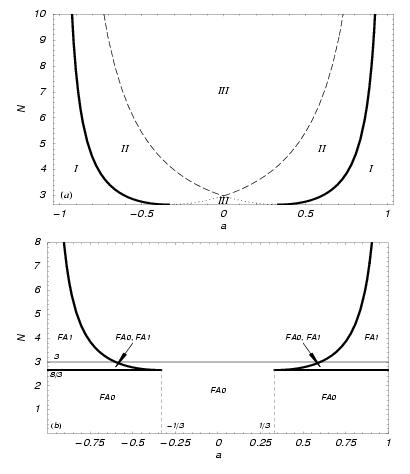
(a): Regions in (a,N) space of shear-aligned nematic steady states.
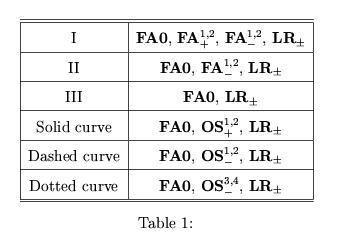
See Table 1 below for specific types of steady states for each region.
The solid boundary between region (I) and (II) corresponds both to loss
of the stable flow-aligning state and existence of the out-of-plane state.
(b): Regions of all stable steady states, both nearly isotropic (FA0)
and nematic (FA1). (Stable logrolling states only emerge for N >> 1).
By M. Gregory Forest, Ruhai Zhou, Qi Wang
The Doi theory has successfully modeled the monodomain shear flow problem
for rigid, rod-like nematic polymers. Numerical simulations of the
Smoluchowski equation for the orientational probability distribution function
(PDF) predict monodomain attractors in regions of nematic concentration
and shear rate. Theoretical work has focused on approximate constructions
of PDF solutions in linear flow regimes. Here we develop a collection of
simple observations, expressed by symmetries of the Smoluchowski equation,
which imply global properties that all PDF solutions must obey. The well-known
orientational degeneracy of quiescent nematics is a continuous O(3) symmetry.
In simple shear: a discrete reflection symmetry survives that is evident
in recent numerical simulations and implies bi-stability of out-of-plane
attractors; and rod-like and discotic nematic liquids of reciprocal aspect
ratio respond identically up to a fixed rotation of the PDF. Finally, we
show the orientational effects due to varying molecular aspect ratio in
any linear flow are equivalent to varying the straining component of the
flow field.