Geochemistry
of Marine Sediments
by David J. Burdige
by David J. Burdige
Welcome to the web site for this book. Hopefully the material here will compliment that which is found in the book, and perhaps enlighten the uninitiated about the wonders of sediment geochemistry.
First things first. To order a copy of the book, you can either:
- order
one directly from Princeton University Press,
- order one from an on-line book-seller such as Amazon.com
or Barnes and Noble,
- go to your local bookstore and order a copy (ISBN #0-691-09506-X)
I'd
love to think
that every small independent bookstore or large bookstore chain around
the world has a copy of the book in stock, but let's be real about
this. By the way, copies of the book make lovely birthday
presents and holiday gifts for loved ones.
Still not sure about buying the book. Read the reviews:
- sediment geochemistry "images" I found while working on the book
- some "thought" questions I have used when I teach my sediment geochemistry course
- a course syllabus (the first time I taught my sediments class with the book I realized that the final chapter order does not work as well for teaching as I thought it would).
- some quantitative problems I've developed over the years for this class (coming soon)
- a list of book corrections, errors, etc. (as of 1/10)
|
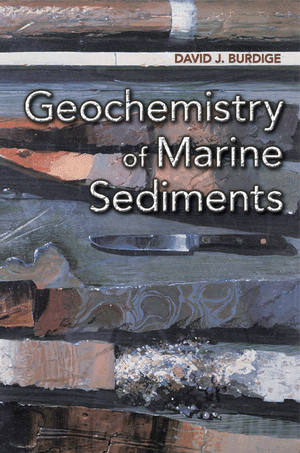
About the book cover: The painting “Sea-Bottom Cores, Lamont Lab” by Stanley Meltzoff, first appeared on the cover of the August, 1956 issue of Scientific American. It can also be found in Scientific American: Art in Science II - A Portfolio of 40 Paintings, Drawings and Photographs (Simon & Schuster/ Scientific American, 1960). For a better view of the entire painting, click here (scroll down to the bottom of this page and click on the painting). At the time it was painted, the caption for the painting read, ”Until recently it was thought that the sea bottom was overlaid with unstratified ooze. The vertical cross sections of the [ocean] bottom represented by these cores show that, on the contrary, deep-sea sediments are often highly stratified, and so contain important clues to the earth’s geological history.” How quickly our thoughts about marine sediments have changed and evolved !!!! This painting illustrates several types of sedimentary features discussed in the text including: laminated (or varved) sediments (bottom left); mottled sediments that commonly occur as a result of bioturbation (below knife); large-scale sediment layers of different colors often associated with the deposition and diagenesis of deep-sea turbidites (above knife). Click here if you are having trouble seeing these features. |