Please read the pages indicated by Z-19 and study Behavioral Objective #27. In places where rainfall is very low, often less than 10 inches per year, not even grasses can survive as the dominant vegetation. This is where desert biomes can be found. Deserts are subject to the most extreme temperature fluctuations of any biome type. During the day they are exposed to intense sunlight and the temperature of both air and soil may rise very high, to 105 degrees or higher; for soil temperature and for surface temperature, to 160 degrees or higher. But in the absence of the moderating influence of abundant vegetation, heat is rapidly lost at night and a short while after sunset searing heat has usually given way to bitter cold. Please look at the map showing the biomes of the world.
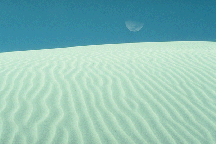 Some
deserts, such as parts of the Sahara, are nearly barren from vegetation.
More commonly there are scattered drought resistant shrubs, such as sage
brush, greasewood, creosot bush, and misquet, as well as succulent plants
that can store much of the water in their tissues, such plants as cactuses
in the New World and euphorbias in the Old World deserts. In addition,
there are often very many small rapid annual growing herbs with seeds that
will germinate only when there is a hard rain. Once these seeds germinate
the young plants shoot up, they flower, they set seed, and die all within
a very few days.
Some
deserts, such as parts of the Sahara, are nearly barren from vegetation.
More commonly there are scattered drought resistant shrubs, such as sage
brush, greasewood, creosot bush, and misquet, as well as succulent plants
that can store much of the water in their tissues, such plants as cactuses
in the New World and euphorbias in the Old World deserts. In addition,
there are often very many small rapid annual growing herbs with seeds that
will germinate only when there is a hard rain. Once these seeds germinate
the young plants shoot up, they flower, they set seed, and die all within
a very few days.
Most desert animals are primarily active at night or during the brief period in the morning or late afternoon when the heat is not so intense nor the cold so hard. During the day they remain in cool underground burrows or cavities of plants, or in the case of some spiders or insects, in the shade of a plant. Among the animals often found in deserts, are rodents, such as the kangaroo rat, snakes, lizards, a few birds, arachnid spiders and insects. Most show numerous remarkable physiological and behavioral adaptations for life in their hostile environment.
Activity: Write a paragraph describing which environmental factors are responsible for the characteristic adaptations demonstrated by the plants and animals in the desert and give examples of the flora and fauna which may be found in this ecosystem’s trophic levels.
Which of the following is not a characteristic of desert inhabitants?
- a. Leaves are modified into spines to discourage herbivores.
- b. Plants have thick juicy stems to store water.
- c. Animal tend to forage at night and remain under cover during the day.
- d. Mammals include large grazing herbivores.
Created by the Multimedia Development Lab, Academic Technology Services.
Last modified November 19, 1997.